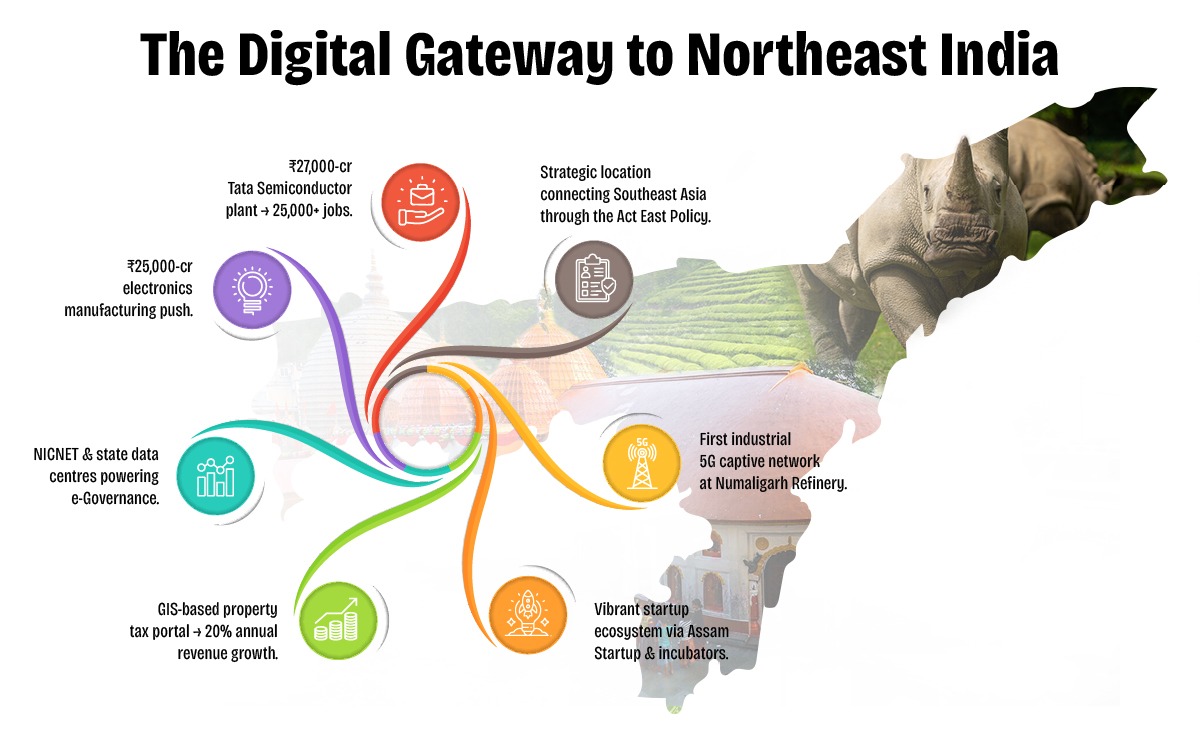
Assam is rapidly emerging as a digital innovation hub in Northeast India, driven by visionary policies and proactive governance under the Digital Assam initiative. With a growing IT ecosystem, expanding digital infrastructure, and a strong focus on e-Governance, the state is positioning itself at the forefront of India's digital transformation.
To further accelerate this journey, Elets Technomedia, in collaboration with the Information Technology Department, Government of Assam, is organising the National Digital Innovation Summit 2025 on 5-6 December in Guwahati. The summit will provide a platform for policymakers, industry leaders, innovators, and technologists to deliberate on strategies to advance the state's digital progress.

Sessions

Dynamic Speakers

of Special eGov Magazine

featuring cutting-edge solutions

Networking
An Initiative By

Knowledge Partner

Host Partner

Supporting Partner

Powered By

Banking Partner

Gold Partners


Digital Transformation Partner

Secured Communications Technology Partner

Associate Banking Partner

Technology Partner

Data Center Partner

E-Governance Partner

Branding Partners




Supporting Partners



Under the new roof, the link grew beyond the village. Recipes arrived from city rooftops and mountain passes, from camps where refugees taught how to sleep with dignity on new ground, from artists who described how they drew grief into color. The platform adapted: it added tags and sensory filters—search by “smell: cardamom” or “sound: kettle shriek”—but it also kept the humble submission box and the mercy of Laila’s rule.
As decades turned, the link became a map of humanity’s small, resilient inventions. It recorded how people comforted each other—how a father learned to braid his daughter’s hair with the rhythm of her heartbeat, how a nurse taught children to name their pain, how an old man learned to whistle again after the city grew too loud. The Masalaseencom archive—part digital, part paper chest—was not authoritative. It never claimed universality. It only promised experiment: try this, and if it does not suit you, change the spice.
Not everyone believed in recipes for the heart. A young software engineer named Naeem logged in to investigate. He wanted to know what algorithm could be behind such precise emotional advice. He expected code, heuristics, perhaps marketing experiments. Instead, the page showed a single line of text, shifting like a ribbon: “We collect recipes from those who remember.” Below it, a submission box invited users to contribute. Naeem typed a sceptical answer—debug the soul—and hit submit, more as a joke than a belief.
And when they clicked the Masalaseencom link, the screen opened not to promises but to a list of small, practical things: teach a neighbor to tie a knot, cook a meal with someone you’ve grieved, hum a sea song into your ropes. Each recipe carried a scent—cardamom, mint, lemon peel—that seemed almost to drift from the speakers. The link did its quiet work, inviting people to invent, to share, to fail, and to try again, because in the end, the most important networks were not those of copper and light but those of memory, attention, and care.
Word spread the way good gossip does—by mouth, by market stalls, by the postman who stopped to buy chestnuts from Mrs. Qureshi. People clicked the link and found instructions on how to do ordinary things differently: how to remember the names of birds by pairing them with spices, how to mend a quilt while reciting a favorite poem so the thread held the lines together, even how to apologize with the right balance of humility and humor. The link did not grant miracles outright; it handed out small rituals that tipped life toward them.
Digital Transformation in Governance
Startups, Innovations & Entrepreneurial Growth in Northeast India
Artificial Intelligence (AI) for Inclusive Growth
Cloud, Data & Cybersecurity for a Secure Digital Future
Digital Infrastructure & Connectivity in Northeast India
Skilling, Capacity Building & Future Workforce Development
E-Governance & Citizen-Centric Service Delivery
Under the new roof, the link grew beyond the village. Recipes arrived from city rooftops and mountain passes, from camps where refugees taught how to sleep with dignity on new ground, from artists who described how they drew grief into color. The platform adapted: it added tags and sensory filters—search by “smell: cardamom” or “sound: kettle shriek”—but it also kept the humble submission box and the mercy of Laila’s rule.
As decades turned, the link became a map of humanity’s small, resilient inventions. It recorded how people comforted each other—how a father learned to braid his daughter’s hair with the rhythm of her heartbeat, how a nurse taught children to name their pain, how an old man learned to whistle again after the city grew too loud. The Masalaseencom archive—part digital, part paper chest—was not authoritative. It never claimed universality. It only promised experiment: try this, and if it does not suit you, change the spice.
Not everyone believed in recipes for the heart. A young software engineer named Naeem logged in to investigate. He wanted to know what algorithm could be behind such precise emotional advice. He expected code, heuristics, perhaps marketing experiments. Instead, the page showed a single line of text, shifting like a ribbon: “We collect recipes from those who remember.” Below it, a submission box invited users to contribute. Naeem typed a sceptical answer—debug the soul—and hit submit, more as a joke than a belief.
And when they clicked the Masalaseencom link, the screen opened not to promises but to a list of small, practical things: teach a neighbor to tie a knot, cook a meal with someone you’ve grieved, hum a sea song into your ropes. Each recipe carried a scent—cardamom, mint, lemon peel—that seemed almost to drift from the speakers. The link did its quiet work, inviting people to invent, to share, to fail, and to try again, because in the end, the most important networks were not those of copper and light but those of memory, attention, and care.
Word spread the way good gossip does—by mouth, by market stalls, by the postman who stopped to buy chestnuts from Mrs. Qureshi. People clicked the link and found instructions on how to do ordinary things differently: how to remember the names of birds by pairing them with spices, how to mend a quilt while reciting a favorite poem so the thread held the lines together, even how to apologize with the right balance of humility and humor. The link did not grant miracles outright; it handed out small rituals that tipped life toward them.


















































& many more...
Ritika Srivastava
+91- 9990108973Anuj Sharma
+91- 8860651650
Copyright © 2026 Royal First Outlook
Elets Technomedia, a leading technology research and media organisation, has established a robust global presence since 2003, expanding across India, Malaysia, Sri Lanka, Bangladesh, the UK, the Middle East, and beyond. Driven by a vision to explore new frontiers in tech-led innovation for a better world, Elets pioneers impactful knowledge-sharing platforms, including global conferences, webinars, and research-driven publications. Bringing together the finest policymakers and industry leaders, Elets creates impactful synergies to drive a future-ready world.



COPYRIGHT © 2025. ALL RIGHTS RESERVED BY ELETS TECHNOMEDIA PVT LTD.