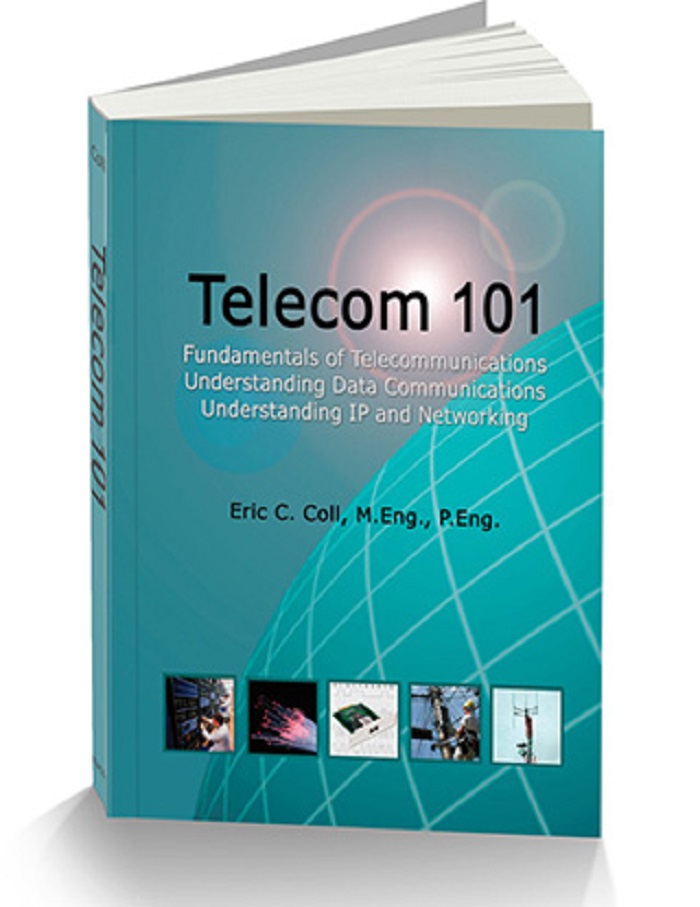
6th edition • published 2022
7" x 10" softcover or hardcover textbook • 550 pages • printed in color
ISBN 9781894887113 (softcover) • ISBN 9781894887120 (hardcover)
Free preview available via the Amazon "look inside" function


eBook (ISBN 9781894887137) available from:



All Major Telecommunications Topics covered ... in Plain English. Packed with up-to-date information and covering all major topics. Telecom 101 is an authoritative day-to-day reference and an invaluable textbook on telecom.
Updated and revised throughout, Telecom 101: Sixth Edition includes the materials from the most recent version of Teracom's popular Course 101 Broadband, Telecom, Datacom and Networking for Non-Engineers, and more topics.
Telecom 101 serves as the study guide for the TCO, Telecommunications Certification Organization, Certified Telecommunications Analyst (CTA) certification, including all required material for the CTA Certification Exam, except the security module.
Telecom 101 brings you completeness, consistency and unbeatable value in one volume.
Our philosophy is simple: Start at the beginning. Proceed in a logical order. Build concepts one on top of another. Speak in plain English. Avoid jargon.
Knowledge and understanding to last a lifetime... Build a solid base of structured knowledge and fill in the gaps. Cut through the doubletalk, demystify the jargon, bust the buzzwords. Understand how everything fits together!
The ideal book for anyone needing an understanding of the major topics in telecom, IP, data communications, and networking. Clear, concise, organized knowledge ... available in one place!
Velian’s pieces from 2021—whether photographic grids that align private snapshots with public gestures, or sculptural assemblages that stitch memory to found materials—operate along two complementary vectors. First, they insist on legibility: the viewer is invited to decode a personal lexicon of marks, gestures, and mnemonic traces. Second, they complicate that legibility by refusing a single, stable narrative. A photograph may be cropped, layered, or physically altered; text may be partially erased; objects juxtaposed in ways that resist linear storytelling. This dialectic—between revelation and obfuscation—mirrors how memory itself behaves, particularly under the pressure of a year defined by loss and liminality.
In 2021, art institutions and viewers alike were still feeling the aftershocks of a global pause that had rearranged how culture was produced, circulated, and experienced. Museums reopened with social-distancing measures and hybrid programming; artists translated isolation, grief, and adaptation into new forms; and scholars reoriented narratives to reckon with urgent conversations about equity, accessibility, and representation. It is in this particular moment that the work of Anita C. Velian—whose practice, for the purposes of this essay, we will treat as emblematic of a generation of artists navigating personal history and public display—offers a compact, resonant case study in how contemporary art negotiates intimacy, identity, and institutional space.
Finally, thinking beyond the gallery, Velian’s 2021 oeuvre resonates with how communities were reconstructing meaning outside institutional walls. The pandemic propelled forms of mutual aid, archival projects, and neighborhood rituals that preserved memory differently. Velian’s work can be read as an aesthetic ally to these practices: it honors small acts, preserves fragile traces, and insists that histories be told from vantage points that institutions have historically marginalized. met art anita c velian 2021
At the Metropolitan Museum ("Met")—here considered as the institutional stage against which contemporary practices are measured—the display of works by artists like Velian highlights a characteristic tension. The Met, with its deep historical holdings and ceremonial grandeur, is at once a site of prestige and an environment that can neutralize the immediacy of contemporary work. When Velian’s intimate fragments enter such a space, they both gain authority and risk being recontextualized within the museum’s grand narrative. A successful presentation in this context depends on curatorial strategies that preserve the intimacy of the work while allowing it to converse with the institution’s scale and audience.
In sum, Anita C. Velian’s presence within the Met’s 2021 landscape exemplifies an important mode of contemporary art-making: small-scale, materially rich, politically aware work that insists on intimacy as a form of resistance. Her pieces do not shout; they whisper histories that ask to be heard. And in a year when the world was relearning how to gather, listen, and remember, that whisper carried an unexpectedly large and necessary weight. A photograph may be cropped, layered, or physically
Velian’s practice can be read as an exploration of the private archive made public: photographs, domestic objects, and fragmentary texts are rearranged into compositions that invite a viewer’s close, almost conspiratorial attention. The materials she chooses—polaroids faded at the edges, handwritten notes, dried flowers—are objects that carry both tenderness and entropy. They are unassuming in isolation, but within a curated gallery context they become unstable carriers of meaning, forcing the viewer to question what remains of a life when memory is made visible.
Technically, Velian’s aesthetic blends analog processes with digital interventions. Polaroid surfaces might be scanned and manipulated; textile fragments stitched with digitally printed overlays. This hybrid methodology reflects 2021’s broader artistic milieu: a moment when hybrid exhibitions—part online archive, part in-person installation—challenged the notion that museum experiences must be singular or physical. It also reinforces Velian’s thematic interest in translation: how memory translates into material, how private acts translate into public narratives, how the tactile becomes readable across platforms. In doing so
The political register of Velian’s 2021 work is subtle but present. In a year when questions of whose stories museums elevate were vocally debated, Velian’s focus on overlooked domestic histories and the small economies of care becomes an implicit critique of institutional grand narratives. By centering objects associated with caregiving and everyday labor, her work pushes back against the art historical tendency to valorize spectacle over sustainment. In doing so, she aligns with a wider cohort of artists foregrounding feminist and decolonial frameworks that revalue the quotidian.
Velian’s pieces from 2021—whether photographic grids that align private snapshots with public gestures, or sculptural assemblages that stitch memory to found materials—operate along two complementary vectors. First, they insist on legibility: the viewer is invited to decode a personal lexicon of marks, gestures, and mnemonic traces. Second, they complicate that legibility by refusing a single, stable narrative. A photograph may be cropped, layered, or physically altered; text may be partially erased; objects juxtaposed in ways that resist linear storytelling. This dialectic—between revelation and obfuscation—mirrors how memory itself behaves, particularly under the pressure of a year defined by loss and liminality.
In 2021, art institutions and viewers alike were still feeling the aftershocks of a global pause that had rearranged how culture was produced, circulated, and experienced. Museums reopened with social-distancing measures and hybrid programming; artists translated isolation, grief, and adaptation into new forms; and scholars reoriented narratives to reckon with urgent conversations about equity, accessibility, and representation. It is in this particular moment that the work of Anita C. Velian—whose practice, for the purposes of this essay, we will treat as emblematic of a generation of artists navigating personal history and public display—offers a compact, resonant case study in how contemporary art negotiates intimacy, identity, and institutional space.
Finally, thinking beyond the gallery, Velian’s 2021 oeuvre resonates with how communities were reconstructing meaning outside institutional walls. The pandemic propelled forms of mutual aid, archival projects, and neighborhood rituals that preserved memory differently. Velian’s work can be read as an aesthetic ally to these practices: it honors small acts, preserves fragile traces, and insists that histories be told from vantage points that institutions have historically marginalized.
At the Metropolitan Museum ("Met")—here considered as the institutional stage against which contemporary practices are measured—the display of works by artists like Velian highlights a characteristic tension. The Met, with its deep historical holdings and ceremonial grandeur, is at once a site of prestige and an environment that can neutralize the immediacy of contemporary work. When Velian’s intimate fragments enter such a space, they both gain authority and risk being recontextualized within the museum’s grand narrative. A successful presentation in this context depends on curatorial strategies that preserve the intimacy of the work while allowing it to converse with the institution’s scale and audience.
In sum, Anita C. Velian’s presence within the Met’s 2021 landscape exemplifies an important mode of contemporary art-making: small-scale, materially rich, politically aware work that insists on intimacy as a form of resistance. Her pieces do not shout; they whisper histories that ask to be heard. And in a year when the world was relearning how to gather, listen, and remember, that whisper carried an unexpectedly large and necessary weight.
Velian’s practice can be read as an exploration of the private archive made public: photographs, domestic objects, and fragmentary texts are rearranged into compositions that invite a viewer’s close, almost conspiratorial attention. The materials she chooses—polaroids faded at the edges, handwritten notes, dried flowers—are objects that carry both tenderness and entropy. They are unassuming in isolation, but within a curated gallery context they become unstable carriers of meaning, forcing the viewer to question what remains of a life when memory is made visible.
Technically, Velian’s aesthetic blends analog processes with digital interventions. Polaroid surfaces might be scanned and manipulated; textile fragments stitched with digitally printed overlays. This hybrid methodology reflects 2021’s broader artistic milieu: a moment when hybrid exhibitions—part online archive, part in-person installation—challenged the notion that museum experiences must be singular or physical. It also reinforces Velian’s thematic interest in translation: how memory translates into material, how private acts translate into public narratives, how the tactile becomes readable across platforms.
The political register of Velian’s 2021 work is subtle but present. In a year when questions of whose stories museums elevate were vocally debated, Velian’s focus on overlooked domestic histories and the small economies of care becomes an implicit critique of institutional grand narratives. By centering objects associated with caregiving and everyday labor, her work pushes back against the art historical tendency to valorize spectacle over sustainment. In doing so, she aligns with a wider cohort of artists foregrounding feminist and decolonial frameworks that revalue the quotidian.
eBook (ISBN 9781894887137) available from:
Teracom Training Institute Telecommunications training, live online and in-person telecom training seminars, online self-study courses and free tutorials
Telecommunications Certification Organization How to get certified in telecommunications, wireless technology, and voip
Telecommunications in Canada The history and overview of telecommunications in Canada