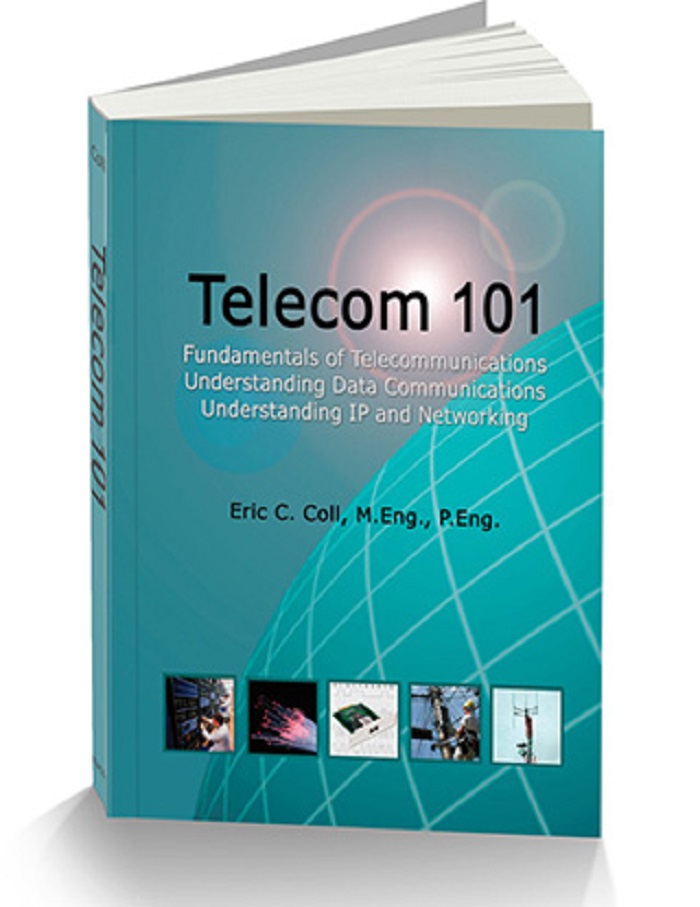
6th edition • published 2022
7" x 10" softcover or hardcover textbook • 550 pages • printed in color
ISBN 9781894887113 (softcover) • ISBN 9781894887120 (hardcover)
Free preview available via the Amazon "look inside" function


eBook (ISBN 9781894887137) available from:



All Major Telecommunications Topics covered ... in Plain English. Packed with up-to-date information and covering all major topics. Telecom 101 is an authoritative day-to-day reference and an invaluable textbook on telecom.
Updated and revised throughout, Telecom 101: Sixth Edition includes the materials from the most recent version of Teracom's popular Course 101 Broadband, Telecom, Datacom and Networking for Non-Engineers, and more topics.
Telecom 101 serves as the study guide for the TCO, Telecommunications Certification Organization, Certified Telecommunications Analyst (CTA) certification, including all required material for the CTA Certification Exam, except the security module.
Telecom 101 brings you completeness, consistency and unbeatable value in one volume.
Our philosophy is simple: Start at the beginning. Proceed in a logical order. Build concepts one on top of another. Speak in plain English. Avoid jargon.
Knowledge and understanding to last a lifetime... Build a solid base of structured knowledge and fill in the gaps. Cut through the doubletalk, demystify the jargon, bust the buzzwords. Understand how everything fits together!
The ideal book for anyone needing an understanding of the major topics in telecom, IP, data communications, and networking. Clear, concise, organized knowledge ... available in one place!
In the end, Ragini did something simple and quiet. She left the file on her screen, closed the lid to her laptop, and walked to the riverbank with a small packet of marigolds. She did not scream or perform exorcism. She did not post an explanatory thread online or edit the viral clips. Instead she set the flowers afloat and listened to the water carry them away. Around her, the city continued its restless chatter—train horns, market vendors, laughter. Somewhere, someone else was clicking “Download.” But for that night, the wail that had become a viral filename softened into something like a memory being honored.
And so the rumor continued—to click or not to click, to stream or to resist—but with a new caveat whispered among neighbors and typed in forum replies: when you press play, listen not just for the jump scares but for the story asking to be witnessed. If you must download, bring something to leave at the riverbank.
Ragini found the link like one finds shortcuts home—out of convenience, not intent. The evening was humid, the monsoon just beginning to drum on tin roofs, and her apartment smelled of boiling chai and drying laundry. She had wanted only an escape: a dubbed horror feature to fill the silence after a long day. Filmyzilla’s page glowed invitingly, the download button a modern amulet promising a night's thrill. She clicked, thinking of nothing but popcorn and the satisfying jolt of a good scare. The Curse Of La Llorona Download In Hindi Filmyzilla
Ragini learned that prohibition was no remedy. The more something was forbidden, the more it fed people’s curiosity and, strangely, their empathy. The download functioned not only as an infection but as a confessional. Viewers reported dreams where they heard a woman calling their names in the pauses between thunder. Those who had lost children or lovers said the film’s voice was a kind of terrible consolation—an affirmation that grief could be seen and heard across formats and borders. Those who had never suffered such loss felt guilt, an ache that was out of place but no less real.
“They are not merely watching,” Desai told Ragini one humid morning. “They are remembering they can be seen.” In the end, Ragini did something simple and quiet
She came to families the way a rumor arrives: soft at first, then impossible to ignore. In the alleys between prayer candles and flickering sari sleeves, an old name was spoken with the same mix of fear and fascination—La Llorona. In this version of the tale, her presence was not only a wail at the riverbank but a knot in the digital age: the promise of a downloadable film file, pixelated sorrow packaged under the innocuous label “The Curse Of La Llorona Download In Hindi Filmyzilla.”
One evening, standing by the river that bisected the city, Ragini met a woman wrapped in a faded dupatta who said only, “You watch to understand or to be understood?” It was the question the film itself posed, whether deliberately or by accident. Ragini realized the download had done something human and unsettling: it had turned passive horror consumption into participation in a ritual. The viewers were no longer just audience; they were witnesses, and in witnessing they made La Llorona’s grief legible again. She did not post an explanatory thread online
If the curse existed, it was less about supernatural retribution and more about attention. La Llorona’s lament had been drowned once by indifference—rivers reclaim what nobody watches. The digital copy, circulating in corners of Filmyzilla and obscure messaging apps, was a reversal: attention looped back, demanding reparations. But attention, in a world of fast clicks and short attention spans, is volatile and shallow. What the download offered, paradoxically, was both depth and dilution. It allowed grief to be seen but also commodified it, turning ritual into a trending file name.
In the end, Ragini did something simple and quiet. She left the file on her screen, closed the lid to her laptop, and walked to the riverbank with a small packet of marigolds. She did not scream or perform exorcism. She did not post an explanatory thread online or edit the viral clips. Instead she set the flowers afloat and listened to the water carry them away. Around her, the city continued its restless chatter—train horns, market vendors, laughter. Somewhere, someone else was clicking “Download.” But for that night, the wail that had become a viral filename softened into something like a memory being honored.
And so the rumor continued—to click or not to click, to stream or to resist—but with a new caveat whispered among neighbors and typed in forum replies: when you press play, listen not just for the jump scares but for the story asking to be witnessed. If you must download, bring something to leave at the riverbank.
Ragini found the link like one finds shortcuts home—out of convenience, not intent. The evening was humid, the monsoon just beginning to drum on tin roofs, and her apartment smelled of boiling chai and drying laundry. She had wanted only an escape: a dubbed horror feature to fill the silence after a long day. Filmyzilla’s page glowed invitingly, the download button a modern amulet promising a night's thrill. She clicked, thinking of nothing but popcorn and the satisfying jolt of a good scare.
Ragini learned that prohibition was no remedy. The more something was forbidden, the more it fed people’s curiosity and, strangely, their empathy. The download functioned not only as an infection but as a confessional. Viewers reported dreams where they heard a woman calling their names in the pauses between thunder. Those who had lost children or lovers said the film’s voice was a kind of terrible consolation—an affirmation that grief could be seen and heard across formats and borders. Those who had never suffered such loss felt guilt, an ache that was out of place but no less real.
“They are not merely watching,” Desai told Ragini one humid morning. “They are remembering they can be seen.”
She came to families the way a rumor arrives: soft at first, then impossible to ignore. In the alleys between prayer candles and flickering sari sleeves, an old name was spoken with the same mix of fear and fascination—La Llorona. In this version of the tale, her presence was not only a wail at the riverbank but a knot in the digital age: the promise of a downloadable film file, pixelated sorrow packaged under the innocuous label “The Curse Of La Llorona Download In Hindi Filmyzilla.”
One evening, standing by the river that bisected the city, Ragini met a woman wrapped in a faded dupatta who said only, “You watch to understand or to be understood?” It was the question the film itself posed, whether deliberately or by accident. Ragini realized the download had done something human and unsettling: it had turned passive horror consumption into participation in a ritual. The viewers were no longer just audience; they were witnesses, and in witnessing they made La Llorona’s grief legible again.
If the curse existed, it was less about supernatural retribution and more about attention. La Llorona’s lament had been drowned once by indifference—rivers reclaim what nobody watches. The digital copy, circulating in corners of Filmyzilla and obscure messaging apps, was a reversal: attention looped back, demanding reparations. But attention, in a world of fast clicks and short attention spans, is volatile and shallow. What the download offered, paradoxically, was both depth and dilution. It allowed grief to be seen but also commodified it, turning ritual into a trending file name.
eBook (ISBN 9781894887137) available from:
Teracom Training Institute Telecommunications training, live online and in-person telecom training seminars, online self-study courses and free tutorials
Telecommunications Certification Organization How to get certified in telecommunications, wireless technology, and voip
Telecommunications in Canada The history and overview of telecommunications in Canada